

Commons:Village pump/Copyright
This Wikimedia Commons page is used for general discussions relating to copyright and license issues, and for discussions relating to specific files' copyright issues. Discussions relating to specific copyright policies should take place on the talk page of the policy, but may be advertised here. Recent sections with no replies for 7 days and sections tagged with {{section resolved|1=~~~~}} may be archived; for old discussions, see the archives.
- One of Wikimedia Commons' basic principles is: "Only free content is allowed." Please do not ask why unfree material is not allowed at Wikimedia Commons or suggest that allowing it would be a good thing.
- Have you read the FAQ?
- Any answers you receive here are not legal advice and the responder cannot be held liable for them. If you have legal questions, we can try to help but our answers cannot replace those of a qualified professional (i.e. a lawyer).
- Your question will be answered here; please check back regularly. Please do not leave your email address or other contact information, as this page is widely visible across the Internet and you are liable to receive spam.
- Please do not make deletion requests here – instead, use the relevant process for it.
 |
SpBot archives all sections tagged with {{Section resolved|1=~~~~}} after 1 day and sections whose most recent comment is older than 7 days. |
Columbia Disaster Apache Footage (US helicopter and Dutch Crew)
[edit]So we all know the video of the breakup of the Columbia Space Shuttle filmed from an Apache Longbow, now we know that the aircraft was in a training mission of the US Army, but the problem is that the crew that were on the Apache (Emco Jellema and Capt. Erik Starmans) are members of the Dutch Army. https://www.chron.com/news/article/dutch-pilots-provide-new-shuttle-view-2084642.php Wouldn't be that a disqualifier of a work of the US Gov. since the footage technically also belongs to the Dutch Air Force? Hyperba21 (talk) 02:41, 18 September 2026 (UTC)

- {{PD-USGov}} is definitely not this case, but perhaps footage was captured by authomatic means, so {{PD-CCTV}}? Evelino Ucelo (talk) 19:32, 20 September 2026 (UTC)
- The operator appears to be manually tracking the fragments, so I doubt {{PD-CCTV}} applies. Based5290 (talk) 20:01, 20 September 2026 (UTC)
- Any weapon system officer with a similar degree of skill would produce a similar result in the same circumstances: there's ground to argue for {{PD-ineligible}} too, as the TOO for copyrights is probably not reached. Regards, Grand-Duc (talk) 20:56, 20 September 2026 (UTC)
- That seems like a pretty big leap as far as U.S. ToO logic goes. Just because the footage is somewhat predictable does not make it unoriginal in the copyright sense. Yes, most people with the training and equipment would have captured it in a similar way. But you could say the same of any number of photographs or videos of other genres: a video tracking a bird flying across a scene, shot by a professional birdwatcher, is probably going to be similar no matter which birdwatcher shot the video. It doesn't mean the resulting footage is so unoriginal as to not merit copyright. 19h00s (talk) 21:44, 20 September 2026 (UTC)
- Making the best efforts to point an image capture device at some scene without regards to composition, framing, etc. should not be "creative", especially not when likely assisted by software used to keep some feature centred on a screen. The FLIR video is quite similar to products made by an actual prepositioned recording device and conforms to the explanation in en:Threshold of originality#United States (for not having enough creativity) IMHO. Regards, Grand-Duc (talk) 01:21, 21 September 2026 (UTC)
- The cameraman obviously is making choices about the composition and framing, though. At the start, they zoom in to get a closer look at the breakup. They initially follow the leading fragments, zoom in but zoom back out upon realizing that the other fragments are not in frame, then focus on the fragments in the middle of the streak. Throughout the video, it appears they are manually tracking the fragments with extremely minimal computer aid (contrast against the w:Pentagon UFO videos, where the automated tracking is obvious). The fact that a work may be amateurish does not mean it is not original or creative. Zapruder could barely keep the camera locked onto Kennedy's motorcade, but there is no question that the Zapruder film is copyrightable, even if another amateur videographer in his position could produce a similar result. Based5290 (talk) 01:31, 21 September 2026 (UTC)
- Making the best efforts to point an image capture device at some scene without regards to composition, framing, etc. should not be "creative", especially not when likely assisted by software used to keep some feature centred on a screen. The FLIR video is quite similar to products made by an actual prepositioned recording device and conforms to the explanation in en:Threshold of originality#United States (for not having enough creativity) IMHO. Regards, Grand-Duc (talk) 01:21, 21 September 2026 (UTC)
- That seems like a pretty big leap as far as U.S. ToO logic goes. Just because the footage is somewhat predictable does not make it unoriginal in the copyright sense. Yes, most people with the training and equipment would have captured it in a similar way. But you could say the same of any number of photographs or videos of other genres: a video tracking a bird flying across a scene, shot by a professional birdwatcher, is probably going to be similar no matter which birdwatcher shot the video. It doesn't mean the resulting footage is so unoriginal as to not merit copyright. 19h00s (talk) 21:44, 20 September 2026 (UTC)
- Any weapon system officer with a similar degree of skill would produce a similar result in the same circumstances: there's ground to argue for {{PD-ineligible}} too, as the TOO for copyrights is probably not reached. Regards, Grand-Duc (talk) 20:56, 20 September 2026 (UTC)
- The operator appears to be manually tracking the fragments, so I doubt {{PD-CCTV}} applies. Based5290 (talk) 20:01, 20 September 2026 (UTC)
- Thanks for all the information and answers, yeah unfortunately I have to side with Duc and Based, so I just submitted the DR of this file. If the english wikipedia wants to use it they have to upload a fair use image tho. Hyperba21 (talk) 23:24, 21 September 2026 (UTC)

I was trying to find proof of publication in the United States in November/December 1950 by looking through a bunch of American newspapers, since this photo was pulled from the AP Newsroom, which includes many photos which were not published at the time of their creation. However, I was unable to find any such publications. Is the guidance at COM:China#Photographs (that without simultaneous US publication, this photo would not be PD in the US) correct? Based5290 (talk) 23:31, 20 September 2026 (UTC)

- @Based5290: probably
 Not OK unless we have explicit evidence of simultaneous publication in US, even though the AP Newsroom page is claiming a copyright date of 1950, which would imply that it was indeed published in that year as US copyright is based on date of publication. The AP page also claims it to be an "official portrait", which implies that it may have been distributed quickly after creation (possibly internationally?) for use as publicity. Then again, that AP page also asserts its own copyright over what it claims to be an "official portrait" of a state leader (the photographer, Chen Zhengqing, was described here as "a well-known Party photographer and former Chief of Communications at Xinhua", so any US copyright should be the property of Xinhua). If subjected to a deletion request, I suspect it will likely be deleted though not without a lengthy debate. – Howardcorn33 (💬) 11:23, 25 September 2026 (UTC)


Kindly review this file. If the screen elements are COM:DM or not. JWilz12345 (Talk|Contributions) 02:56, 22 September 2026 (UTC)

- Also: File:Xiaomi 17 T Pro 2026-08-08 flagship.jpg. JWilz12345 (Talk|Contributions) 02:56, 22 September 2026 (UTC)

Revision of COM:HIRTLE required for US status of foreign works
[edit]In the discussion of an undeletion request, COM:HIRTLE in the current state was revealed to be wrong, or at least unclear. The problem was evident in my requested case, but it would be general problem if we need to judge the US copyright status of foreign works which was not in PD in the source country on the URAA date.

(pinging the participants of the previous discussion: @Evelino Ucelo, @Based5290, @Jameslwoodward, @Prosfilaes)
So let's start with my case: 0) the work was created in 1953, by the author who died in 1959, but first published in 1983; 1) the work is now in PD in Japan due to 50 yrs pma before 2018 (=2009); 2) the work was not in PD in Japan on the URAA date for Japan (1996); 3) the US protection judged according to COM:HIRTLE (not Hirtle's original chart) is that the work is in PD (see below); 4) the US term judged according to Hirtle's original chart is 70 yrs pma (=2029).
My reading of the current COM:HIRTLE:
- This work is "Works Published Abroad After 1 January 1978" > date of publication is "1 January 1978 or later " & "Published either with or without copyright notice, and not in the public domain in its home country as of URAA date" so redirected to "Use the US publication chart to determine duration"; this is URAA restoration. Then, to judge the restored copyright, this work is published in "1978 through 28 February 1989" & "without notice, and without subsequent registration within 5 years" resulting "In the public domain due to failure to comply with required formalities".
In @Based5290's opinion, COM:HIRTLE should state "Use the US publication chart to determine duration as if all formalities were followed", and my reading in such way is that the US term continues until 2047 (I guess the basis is §303).
Hirtle's original chart states the copyright protection will expire at the end of 2029; based on @Based5290's suggestion, it would be by 2047. Please also note that the current version of Hirtle's chart at Cornell University are different from the original. Which is correct? How should we revise COM:HIRTLE? Mzaki (talk) 06:18, 22 September 2026 (UTC)
- In the fact, restored foreign works, published in 1978 or later, are under copyright in the United States, apart from one theoretical possibility: a work was published in 2003 or later in some country without copyright relations with the US on the time of publication and the author died more than 70 years ago. Evelino Ucelo (talk) 20:05, 22 September 2026 (UTC)
- No, works published in 2003 or later are simply life+70, no matter where they were published, as long as the US had the relevant copyright relations; otherwise it doesn't matter when the author died, they don't have copyright in the US.--Prosfilaes (talk) 05:07, 23 September 2026 (UTC)
- @Mzaki: I believe you are misunderstanding "Use the US publication chart to determine duration." Obviously, works with copyright restored under URAA did not previously conform to U.S. copyright formalities or they would already have had U.S. copyright in 1996. Basically what "Use the US publication chart to determine duration" means is simply that the expiration date is the same as if the published work had conformed to any U.S.-required formalities (notification, renewal, registration). Perhaps this could be worded more clearly, but it is not wrong. - Jmabel ! talk 20:59, 23 September 2026 (UTC)
- @Jmabel, so how do you worded more clearly? I think the current COM:HIRTLE must be revised, whether it is actually wrong or just unclear. Mzaki (talk) 01:49, 29 September 2026 (UTC)
- I think the best and easiest way is to update COM:HIRTLE to reflect the current version of Hirtle's chart at Cornell University. How about that? @Evelino Ucelo, @Prosfilaes, @Jmabel Mzaki (talk) 01:53, 29 September 2026 (UTC)
Italian WLM app and authorizations
[edit]Reposting here from the WLM Help Desk:
The Italian edition directs to http://app.wikilovesmonuments.it/ for the list of allowed monuments in Italy. Can anyone confirm they were all authorized by the responsible institution before being listed? I ask because some institutions explicitly forbid taking pictures or require fees for them, for example the Botanical garden of Padova (see the Regolamento concessione spazi e immagini/riprese on their authorization page).
I remember a public authorization repository from previous editions but I can't find it, if it's still available a link would be very useful.
CosyCobra (talk) 20:08, 22 September 2026 (UTC)
- I found the authorization archive, but the confirmation about the app would still be useful. CosyCobra (talk) 21:15, 26 September 2026 (UTC)
- @CosyCobra: I'm guessing from the general lack of response that no one involved with that is watching this board, and you'd do better to try to identify them and contact them more directly (at least ping). - Jmabel ! talk 14:44, 27 September 2026 (UTC)
- Yes, I supposed someone was watching the WLM Help Desk or here, but let's try... Maybe @Dario Crespi (WMIT) can help? -- CosyCobra (talk) 19:36, 27 September 2026 (UTC)
- @CosyCobra: I'm guessing from the general lack of response that no one involved with that is watching this board, and you'd do better to try to identify them and contact them more directly (at least ping). - Jmabel ! talk 14:44, 27 September 2026 (UTC)
Syro - Aphex Twin's album cover and originality
[edit]Is there a reason why Syro's album covers on its Wikipedia page are fair use and not on commons? To me it seems like it would fall under the threshold of originality (simple geometry, text, etc.) Just looking for clarification because I assume that there's a reason Subway572 (talk) 05:59, 23 September 2026 (UTC)
- @Subway572: I assume you mean the Wikipedia page Syro, and that the files you are talking about are cen:File:Aphex_twin_syro.jpg and en:File:Aphex Twin - Syro alt cover.jpg. Please link article and file pages when referring to them. - Jmabel ! talk 21:09, 23 September 2026 (UTC)
- I would say that given that we've accepted the Aphex Twin logo in other contexts, en:File:Aphex Twin - Syro alt cover.jpg has to be equally acceptable. en:File:Aphex Twin - Syro alt cover.jpg might be a different story because of the considerable amount of text. The typography isn't copyrightable, but the text might be copyrightable in its own right. (Also: I don't see that graphic on the page that it links as a source.) - Jmabel ! talk 21:09, 23 September 2026 (UTC)


Uploading a Map
[edit]Hey! I'm looking to upload a scan of a map from 1908 made by Costarican Congressman Octavio Quesada, which was uploaded to a publicly accessible pdf on SINABI (or the Nacional System of Libraries). It should be within the public domain as under however I'm unsure. Thank you! Marigoldhill7 (talk) 06:04, 23 September 2026 (UTC)
- @Marigoldhill7: please, in the future, when referring to a file it is much more useful to link it than to describe it in words.
- A faithful scan of a 2-dimensional object has no copyright of its own, it would simply be the copyright (if any) of the underlying work.
- Assuming Quesada died no later that 1955, this is in the public domain in Costa Rica. Assuming it was published shortly after creation (or any time no later than 1930) it is in the public domain in the United States. - Jmabel ! talk 21:14, 23 September 2026 (UTC)
- I'll keep that in mind for the future. Thank you! Marigoldhill7 (talk) 22:28, 23 September 2026 (UTC)
Policía Metropolitana de Caracas
[edit]Is this logo simple enough to be in the public domain? [1] If not, would removing the outer layer and leaving only the circle be enough for this? NoonIcarus (talk) 12:44, 23 September 2026 (UTC)
- @NoonIcarus: the matter of the design itself may be moot, as the logo of a public sector organization in Venezuela is public domain anyway per COM:GVT Venezuela. – Howardcorn33 (💬) 11:05, 25 September 2026 (UTC)
- @Howardcorn33: I'm aware, I wanted to make sure because I'm not sure if this also applies if it is a defunct organization. I'll bear it in mind, thank you. --NoonIcarus (talk) 12:24, 25 September 2026 (UTC)
File:Dainik Jagran newspaper logo.jpg
[edit]File:Dainik Jagran newspaper logo.jpg is probably OK for Commons per COM:TOO US, but I'm not sure if it's OK per COM:TOO India. Can this be kept per COM:PUBLISH or doesn't it need to be deleted per COM:PCP? -- Marchjuly (talk) 22:32, 23 September 2026 (UTC)


- I'm not entirely sure on its status in India, COM:TOO India suggests it should be fine as Indian TOO is similar to US TOO. – Howardcorn33 (💬) 11:01, 25 September 2026 (UTC)

I presume it is PD-textlogo, but I want to double-check it just in case. -- Duppertip (talk) 08:50, 24 September 2026 (UTC)

- In the U.S., certainly. We don't seem to have anything about the threshold of originality in Estonia, though in other respects they do not tend to be a country that gives copyright as broadly as some. - Jmabel ! talk 10:51, 25 September 2026 (UTC)
Query about the copyright status of an image
[edit]What would the copyright status of this image from this news article by The Wire be, and would it be okay for me to publish it to Commons? — EarthDude (Talk) 20:16, 24 September 2026 (UTC)
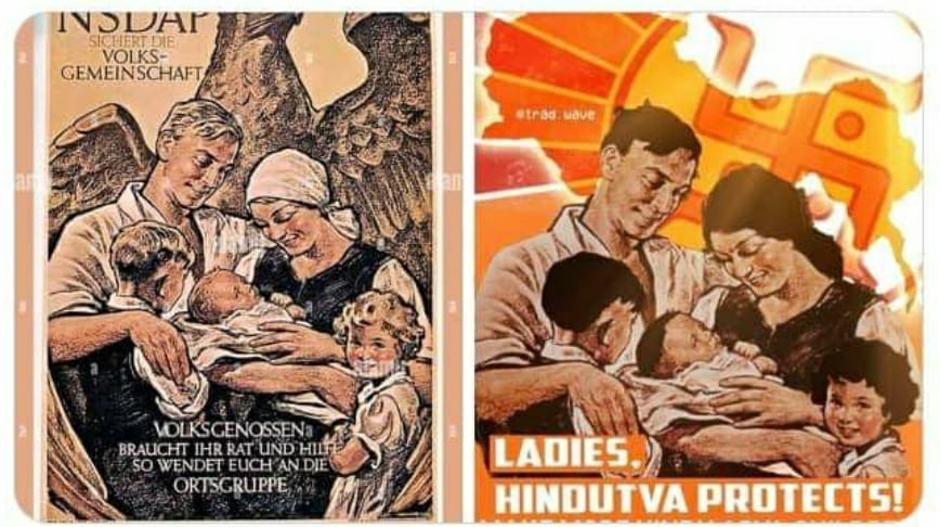
- Convenience links:
- the original Nazi poster, whose creator René Ahrlé (Q1359165) died in 1976.
- German copyright guidance for "official works published in the official interest for general information purposes", unclear to me if this applies to Nazi visual propaganda like this.
- Lovelano (talk) 22:14, 24 September 2026 (UTC)
Threshold of originality of Hermitcraft Season 11 logo
[edit]Hello, I'm Dare2Leap. I want to ask: does https://hermitcraft.fandom.com/wiki/File:Season_11_Header.png meet the threshold of originality for copyright protection (created by a Polish artist)? If not, can I upload it to Commons? It is for the upcoming article w:Draft:Hermitcraft There was a fair use warning in that Wiki, but the picture only uses simple geometric shapes & 3-4 colors, and doesn't use gradients.

Thanks! Dare2Leap (talk) 23:32, 24 September 2026 (UTC)
- In my opinion, it fails to reach the threshold of originality. The logo is nothing more than some text with a colored border, alternating between 3 different colors. If more complex logos over at Category:PD textlogo fail the threshold, so should this image. Oakchris1955 (talk) 07:24, 25 September 2026 (UTC)
- The logo is most likely under COM:TOO US, as the design is very simple. However, I'm not sure if it is under COM:TOO Poland though. The page did mention the TOO in Poland is "rather low", and there isn't much information there either. Thanks. Tvpuppy (talk) 10:46, 25 September 2026 (UTC)
Email screenshots
[edit]I'm curious about the copyright status of File:Paid editing offer.jpg and File:Recived mail from wiki user.jpg uploaded by someone asking for help at the English Wikipedia help desk. Are such screenshots OK for Commons per c:COM:SCREENSHOT? Do the countries of the email's sender and receiver matter when it comes to assessing copyright status? -- Marchjuly (talk) 01:27, 25 September 2026 (UTC)


- The latter does not appear to me to be copyrightable. Not sure about the former. - Jmabel ! talk 10:55, 25 September 2026 (UTC)
- My thoughts FWIW, applying US law: (1) I don't think there is a screenshot issue here, as I don't see any evidently copyrightable elements in the screenshots other than the text. (2) As to the text, agree with Jmabel that the text in the second image is uncopyrightable. My personal opinion is that the text in the first image is also most likely uncopyrightable, since it is brief, utilitarian, and has no evident original expression. It just says what anyone trying to make this pitch would have to say. Definitely a bit dicier though. (3) I am a bit at sea on the source country question, assuming that this is the type of work that would be considered to have a separate source country in the first place. To the extent we would roughly follow the Berne Convention's Article 5 "country of origin" scheme, the source country of the email as an unpublished work would seem to be the country "of which the author is a national", assuming that could be determined. But maybe I am on the wrong track here. (4) Setting copyright aside, it seems to me that there might also be a out of scope problem here, because these are in substance just images of text, which Commons generally does not host. However, I imagine this might be considered a common-sense exception to that rule. -- Visviva (talk) 04:20, 26 September 2026 (UTC)
- Thank you Jmabel and Visviva. I thought the first email (with more text) might possibly be eligible for copyright protection but perhaps it matters not now that the uploader has been indefinitely blocked (globally locked) for sockpuppetry and the files have been deleted by Lymantria. -- Marchjuly (talk) 02:51, 28 September 2026 (UTC)
Limits of PD-CAGov?
[edit]I'm trying to figure out if w:File:WendtPSA.jpg falls under {{PD-CAGov}}. It was taken by chief photographer for San Diego County Hans Wendt while he was covering a different press event. However, Wendt signed an agreement with the county commissioner transferring the rights over the image back to Wendt. Wendt subsequently registered the photograph with the Copyright Office ([2] or [3]), probably preventing forfeiture from failure to affix a proper copyright notice. Can Wendt really enforce a valid copyright over the image? On one hand, County of Santa Clara v. CFAC ruled that the California Public Records Act contains no provisions [...] for copyrighting
a work by the state government. If a copyright cannot exist from the start, then Wendt can't have a copyright as there would be nothing to transfer to him. On the other hand, City of Inglewood v. Joseph Teixeira, et al (from a lower court) says It is true that the court [in County of Santa Clara] was perhaps inartful in its precise choice of language
and that County of Santa Clara may have meant that California government bodies could technically own a valid copyright but could not enforce it in any meaningful way. If City of Inglewood has the correct interpretation, perhaps the transfer of the copyright to a private individual could allow said individual to enforce the copyright. Any thoughts? Based5290 :3 (talk) 04:04, 25 September 2026 (UTC)

- It seems like a threshold question would be whether the Wikipedia file description is correct when it states that "The county designated Wendt as having been on vacation at the time in order that he may retain copyright." If so, then the question isn't really whether the county could hold copyright but whether such a retroactive designation by the county could be effective. If that is what it comes down to, IMO the precautionary principle would militate against basing a PD designation on our belief that a county personnel decision from decades ago was legally flawed. -- Visviva (talk) 03:15, 26 September 2026 (UTC)
- I would not claim the image is PD. There is an ugly fact pattern that is also contradictory. Imagine claiming the image is PD only to have a user defend in court. For me, that means COM:PCP dictates assuming the copyright is valid. I am sympathetic to parts of the PD argument. The image might be within Wendt's scope of employment. The crash was in San Diego County, he might have been working, and he might have used County-owned equipment. But there might be arguments against that. Wendt might have been assigned to photograph some other specific event. He might have been on a break when he saw the plane. If Wendt was on vacation at the time, then the County would have no claim to the photograph. The suggested transfer may not be a transfer but just an acknowledgement that Wendt took the photograph on his own time. We do not have enough information, there is a copyright registration, and we should presume that there is a copyright. Glrx (talk) 17:30, 26 September 2026 (UTC)
Utilizzo del logo di una band dopo esplicito permesso
[edit]Dopo aver ottenuto il permesso dall'etichetta discografica di utilizzare il logo di una band su Wikipedia, sarebbe possibile aggiungerlo anche se protetto ancora da copyright? Imeo99 (talk) 12:48, 25 September 2026 (UTC)
- @Imeo99: There seem to be some leaps of logic there, but something like this could be done. Apologies for the English-language reply; I can read Italian, but do not write it well enough to explain the answer.
- Why would the record label own the copyright to the band's logo? Normally, that would belong either to the band or to the designer of the logo.
- What exactly you mean by "permesso" ("permission")? If you mean a free license suitable for Commons granted by the copyright-holder of the logo, then yes. Otherwise, no.
- If the record label really owns the copyright and would grant a free license such as {{CC-BY 4.0}} (the most likely license for this purpose), they are almost certainly going to have to go through the COM:VRT process (described in Italian at Commons:Volunteer_Response_Team/it) to assert that, because unless they will actually state that in writing, we'd have no reason to believe that the record label owned the copyright.
- - Jmabel ! talk 14:15, 25 September 2026 (UTC)
- Thanks for the response, no problem for the english language.
- So I checked and yes, the band owns the logo rights (I don't know why I wrote about the label, my mistake), in this case what should be the procedure to implement the logo on the page without infringing any rule? Imeo99 (talk) 18:27, 27 September 2026 (UTC)
- @Imeo99: Assuming that the logo (which you have not linked) is above the threshold of originality, then to upload to Commons we would need a free license granted by the band; in this case, it would almost certainly have to go through the COM:VRT process.
- As for uploading a non-free logo locally to Wikipedia without involving Commons, each Wikipedia has its own policies. For en-wiki, see en:Wikipedia:Non-free content and en:Template:Logo rationale. For it-wiki, it looks like it:Wikipedia:File non liberi is the place to start, though I've never read it. it:Wikipedia:Copyright immagini#Exemption Doctrine Policy (EDP) is probably also relevant.- Jmabel ! talk 19:20, 27 September 2026 (UTC)
Weimar Reichstag MPs official portraits
[edit]I want to add more images of Reichstag deputies from the Weimar Republic era. I noticed that something similar already exists, like https://commons.wikimedia.org/wiki/Category:Reichstag_Handbook_(1928). I’d like to add portraits from https://www.reichstag-abgeordnetendatenbank.de/ or at least from https://www.digitale-sammlungen.de/en/view/bsb00000004?page=522 However, I’m not sure about the proper approach. I briefly considered—in a sort of "cargo cult" fashion—simply copying the descriptions used for the 1928 images on Wikimedia Commons, but that didn't seem quite right to me. Отправить отзыв Нажмите на вкладку IStorik1991 (talk) 17:50, 26 September 2026 (UTC)
- @IStorik1991: nothing there immediately shows me why these would be PD or free-licensed.
- Assuming you have that worked out, captions from the time are acceptable as long as they are identified as such. See for example how we handle File:1923 Arthur Martens Rhön.png. - Jmabel ! talk 18:44, 26 September 2026 (UTC)
- To be honest, I actually don't know whether they are in the public domain or not—and I'm not sure how to determine that from the information available at the links. IStorik1991 (talk) 18:47, 26 September 2026 (UTC)
- These portraits are PD in the United States (which is required for hosting this), as works published before 1931. As to the German situation, check if they attribute a particular photographer or studio in https://www.digitale-sammlungen.de/en/view/bsb00000004. German copyright lasts for 70 years after publication if no author is identified, or life + 70 if there is an author (so it would be public domain if they died in 1955 or earlier). Based5290 :3 (talk) 19:01, 26 September 2026 (UTC)
- Thanks! Honestly I dont see any kind of photographer or studio there in their portraits, but this info is helpful IStorik1991 (talk) 19:41, 26 September 2026 (UTC)
- To be fair, I am not sure there to look there for this IStorik1991 (talk) 19:42, 26 September 2026 (UTC)
- Thanks! Honestly I dont see any kind of photographer or studio there in their portraits, but this info is helpful IStorik1991 (talk) 19:41, 26 September 2026 (UTC)
- These portraits are PD in the United States (which is required for hosting this), as works published before 1931. As to the German situation, check if they attribute a particular photographer or studio in https://www.digitale-sammlungen.de/en/view/bsb00000004. German copyright lasts for 70 years after publication if no author is identified, or life + 70 if there is an author (so it would be public domain if they died in 1955 or earlier). Based5290 :3 (talk) 19:01, 26 September 2026 (UTC)
- To be honest, I actually don't know whether they are in the public domain or not—and I'm not sure how to determine that from the information available at the links. IStorik1991 (talk) 18:47, 26 September 2026 (UTC)
- If the photos currently in Category:Reichstag Handbook (1928) are correctly tagged with {{PD-Germany-§134}}, then it would seem that would also apply to any other photos published similarly during the Weimar period (and for some time after). However, I am a little unclear on the validity of declaring these photos to be a "literary or musical work" (I guess because they were published in a book?), so I am not sure if there may be a problem there.
But! On the third hand, I would be curious to know if the life+70 term would apply to works whose protection had already lapsed before that provision came into force. It seems that Lichtbildwerke were only protected for 10 years from publication under the 1907 statute. That was extended to 25 years in 1940 (but the extension did not apply to works that had already lapsed). The modern UrhG came into force in 1965 but did not initially change that 25-year term. At least one previous discussion seems to have assumed that the Copyright Duration Directive reinstated all lapsed copyrights in 1995. However, I'm not sure if that is correct, and UrhG § 137a indicates that the modern duration doesn't apply if a photographic work's copyright protection lapsed before 1985. But given that we don't already have a template for that scenario, I expect I am missing something.-- Visviva (talk) 03:33, 27 September 2026 (UTC)Noting here for posterity that I was indeed missing something, which is the OLG Hamburg's decision at wikisource:de:Oberlandesgericht Hamburg - U-Boot Foto 1941. Although the situation there differs somewhat in that the photo would still have been under protection when the UrhG was enacted, it doesn't seem like that would affect the outcome. So there would likely need to be some other ground, such as 134 if applicable, to consider these photos public domain. -- Visviva (talk) 04:29, 27 September 2026 (UTC)


German agitation posters from the Weimar Republic era.
[edit]I’ve noticed that Wikimedia Commons sometimes hosts political party posters from the 1920s. The ones I’ve seen generally rely on the fact that the creator has died and the work has entered the public domain—like this one: https://commons.wikimedia.org/wiki/File:Wie_ein_Blitz_(DNVP_election_poster).jpg But what about posters where the creator isn't listed? Can you simply count 70 years from the date of publication and leave it at that? For instance, here only the publisher and the commissioning party are listed: https://www.deutsche-digitale-bibliothek.de/item/GX4W4CKALSYRZRPOIDUYNESI7GF3X6CU https://www.deutsche-digitale-bibliothek.de/item/CHIYQ2O22YRU2X7UZYNQMVH5FF4TDXSW Or here, for example: https://www.deutsche-digitale-bibliothek.de/item/OPJFV46ZBE2SUAT66E3AYIAIMVLMFV2C In cases like these, do I need to track down the death date of a specific person (like a certain Robert Müller), or can I simply use the publication date associated with the party that issued it? IStorik1991 (talk) 18:34, 26 September 2026 (UTC)

- @IStorik1991: if you are unable to attribute the poster to any named individual for a work published prior to 1931, then {{PD-EU-anonymous}} applies. If you know the name of the individual author but can not ascertain the time (year or decade) of death through the Internet, then you would probably have to track down the death date through more extensive means (eg. consulting a historian, historical archives, etc.). The bar for Commons for works in life+70y countries with a named author who died in an unknown year is creation+120y per {{PD-old-assumed}}, so that excludes any works after 1906. – Howardcorn33 (💬) 19:44, 26 September 2026 (UTC)
Copyright status of an unpublished 1967 photograph taken in South Korea
[edit]I previously posted this question inadvertently on the talk page of this Village Pump and was advised to repost it here.
I would appreciate advice on the copyright status of this photograph.
The photograph is a portrait of my father, Nak-ku Choi (1918–2003), taken in Seoul, South Korea, in 1967. The then-president of Samhwa Printing Co., who was personally acquainted with my father, arranged for the photograph to be taken by one of the company's employees and gave the resulting print directly to my father. The photographer's identity is unknown. The print remained in my father's possession and subsequently with our family. To the best of my knowledge, the photograph was never published or publicly distributed before its recent use on Wikipedia. The photographer is unknown, and I do not know whether copyright was formally transferred to my father when the print was given to him.
A reduced-resolution copy is currently used as non-free content on English Wikipedia: en:File:Nak-ku Choi portrait 1967.jpg

The same photograph has also recently been uploaded locally to Korean Wikipedia: ko:File:최낙구.jpeg

I understand from Commons:Copyright rules by territory/South Korea that photographs made before January 1, 1977 may have a particular copyright status under South Korean law. I would therefore be grateful for advice on:
- Whether this 1967 photograph is now in the public domain in South Korea;
- Whether its apparently unpublished status affects that conclusion;
- Whether it is also in the public domain in the United States for purposes of hosting it on Wikimedia Commons; and
- If it is eligible for Commons, which copyright template should be used.
I would prefer not to claim that my family owns the copyright unless that can be established from the circumstances described above.
Thank you for your help. Marsuuni (talk) 03:42, 27 September 2026 (UTC)
- FWIW, I believe that the template {{PD-South Korea-photo-1977}} accurately summarizes the statutes to which it refers. And I am not aware of any reason to doubt the resulting conclusion that the photograph is free of copyright in South Korea due to its then-applicable 10-year term having elapsed. However, based on your summary, it seems that the photograph is probably unpublished (note that a "limited publication", such as presenting the photo to the subject, is generally not considered publication under US law). Regrettably, 17 USC 104(a) means that the US's rather excessive 120-year term for unpublished works for hire applies regardless of the country of origin. And based on what you say, it seems like under US law, this would most likely be considered a work for hire done on behalf of Samhwa Printing Co. Thus, Samhwa Printing Co. probably still owns this US-only copyright. It looks like the company is still around -- perhaps it could be persuaded to transfer its rights to you, or release the photo under a free license? Unfortunately, as things stand, it seems to me that this would be out of range for Commons, because works hosted here must be free in both their source country and the US. I'll confess I find this outcome a bit absurd, but I'm not seeing a way around it in this case. -- Visviva (talk) 07:04, 27 September 2026 (UTC)
- However, Samhwa Printing Co. still exists and if they own the copyright, they could grant a free license. - Jmabel ! talk 14:52, 27 September 2026 (UTC)
- I should add one fact that may be relevant. The photograph was included in my father's memoir, which he himself wrote and prepared, including the placement of this photograph. The book was not published during his lifetime, however. I subsequently published it posthumously in 2026. To the best of my knowledge, this was the first public publication of the photograph, unless the giving of the original print to my father in 1967 itself constituted publication.
- Does this subsequent publication affect the U.S. copyright analysis discussed above? Marsuuni (talk) 00:41, 28 September 2026 (UTC)
- I don't think it would affect the analysis. Per section 1902 of the Compendium of US Copyright Office Practices,
an unauthorized distribution of copies or phonorecords does not constitute publication.
(That said, there's enough going on here that reasonable people could come to different conclusions about whether that initial transfer was a publication, as you suggest; however, without evidence one way or the other, I think caution requires that we assume it was not.) -- Visviva (talk) 02:28, 28 September 2026 (UTC)
- I don't think it would affect the analysis. Per section 1902 of the Compendium of US Copyright Office Practices,

This drawing is dated by 1914, but author, date of publication or country of origin isn't known, so perhaps is should be deleted under COM:PCP? (I not want to create unnecessary DR, so I decided to ask first). Evelino Ucelo (talk) 15:56, 27 September 2026 (UTC)

- @Evelino Ucelo: here is the link to Alamy, which in turn gives the source as "Grande Geographie Bong Illustree, 1914". According to this article, this was an illustrated encyclopedia published by French publisher Bong & Cie in 1914 under the direction of Onésime Reclus. I was able to find several auction and direct purchase listings of the book online, but no full scan. Given that we know the photo was taken from the book, and that the book was published in 1914, it is public domain in the US per {{PD-US-expired}} and in France per {{PD-France}}. – Howardcorn33 (💬) 16:43, 27 September 2026 (UTC)
Files deleted in Category:Carhenge
[edit]There was a deletion request regarding files in Category:Carhenge due to the lack of freedom of panorama in the United States. This 3D work was created in 1987, and so theoretically could have {{PD-US-defective notice-1978-89}} be applicable to it (as with all works created in 1987). One of the clauses for this license template to apply is that the work be published (meaning that tangible copies were sold). In my reply to the deletion request, I questioned what exactly constitutes a work being sold; specifically, whether a third party selling reproductions of the 3D work counts as publication. However, this deletion request was closed per nomination, despite my question remaining unanswered. Could there be a reexamination of this case considering the question of "publication" in relation to my question in that deletion request? If the decision to delete is still reached, could someone explain to me the nuances of what counts as "publication" in this case (just for my own knowledge)? ForeverFlying (talk) 03:06, 28 September 2026 (UTC)
- Just an aside: what constitutes "publication" for sculptures in the U.S. can be a pretty vexed issue, somewhat clarified in (I think) 1978, but not retroactively. Starting with works created 1 March 1989 or later, it's much less relevant (copyrights started to be based primarily on creation rather than publication). - Jmabel ! talk 06:41, 28 September 2026 (UTC)
File:KRON's original logo (1949).png
[edit]File:KRON's original logo (1949).png has been tagged with {{Wrong license}} since October 2024, and I tend to agree that the {{CC-zero}} licensed chosen by the uploader is wrong. The question, though, is whether this can be relicensed to something else (maybe {{PD-US-not renewed}} or {{PD-US-no notice}}) or does it need to be deleted. The source provided for the file is to Logopedia, which is basically no help is determining the file's provenance (other than perhaps the year 1949). It's possible this is a screenshot from an early KRON broadcast, but I don't know how to determine that. Does anyone know whether early US TV broadcasts and station IDs typically had copyright notices? I'm pretty sure they all do these days even though there's no longer required per se. In 1949, though, US copyright was different and a valid proper notice would've been required in addition to the other copyright formalities. -- Marchjuly (talk) 07:13, 28 September 2026 (UTC)


- Chance of them having renewed that copyright is close to zero. - Jmabel ! talk 08:42, 28 September 2026 (UTC)
- Sure looks like a newsprint scan. So probably from a newspaper ad somewhere. San Francisco Chronicle (who had the same parent company as KRON-TV at least initially) did not renew their issues (though some specific contributions were[4]). I would go with PD-US-not-renewed as the most likely. TV broadcasts were technically not publication so lack of notice probably not meaningful. Carl Lindberg (talk) 12:04, 28 September 2026 (UTC)
- Thank you Jmabel and Carl for taking a look at this. Based on what you both posted, I'm assuming that relicensing this as {{PD-US-not renewed}} would be preferable to leaving it as {{CC-zero}}, right? -- Marchjuly (talk) 01:32, 29 September 2026 (UTC)
Einstein's Correspondence
[edit]Hi, Some people at Wikisource have been proofreading Einstein's Correspondence: s:Author:Albert Einstein#Correspondence, of which Commons hosts the scans: Category:Einstein-Brunauer letters. The license used up to now (PD-USGov) is IMO not OK. Einstein was never an employee of the US government. I think they could be either {{PD-US-unpublished}} or {{PD-US-no-notice}}. What is the proper license for these documents? Please see s:Wikisource:Copyright discussions#Einstein's Correspondence for the discussion. Thanks, Yann (talk) 12:52, 28 September 2026 (UTC)
- Depends on what kind of definition of "publication", we use. If sending a letter is considered publication of that letter then {{PD-US-no notice}} is applicable. Otherwise {{PD-US-unpublished}} is fine as Einstein died more than 70y ago. – Howardcorn33 (💬) 17:42, 28 September 2026 (UTC)
- Hm. If we don't count initial sending of the letters as publication, then it appears PD-US-unpublished is inapplicable as some contents of the letters were published in books prior to 2003:
- File:Letter of Albert Einstein to the Lieutenant Stephen Brunauer, U.S. Navy Bureau of Ordnance - NARA - 305247 (page 1).jpg
- File:Letter of Albert Einstein to the Lieutenant Stephen Brunauer, U.S. Navy Bureau of Ordnance - NARA - 305249.jpg
- File:Letter of Albert Einstein to the Lieutenant Stephen Brunauer, U.S. Navy Bureau of Ordnance - NARA - 305252 (page 1).jpg
- Some of the letters I checked did not come up with textual matches, so it appears not all were published prior to 2003. Tho the issue is moot anyway if it turns out publication occurred at the initial sending of the letters. – Howardcorn33 (💬) 20:32, 28 September 2026 (UTC)
- Hm. If we don't count initial sending of the letters as publication, then it appears PD-US-unpublished is inapplicable as some contents of the letters were published in books prior to 2003:


Florence Bacong Choe
[edit]Salutations,
@Marchjuly: has brought up a concern about a fair use image I uploaded to English Wikipedia that is en:w:File:Florence Bacong Choe military photograph 2008.jpg. It was uploaded to Facebook by the subject's brother here. While I think it is an official photograph used in a United States Navy Promotion Evaluation Packet, I could not find a public domain copy of it on a United States Navy or United States Government website, including DIVDS. Erring on the side of caution, I uploaded the image as a fair use image, as I can reliably state it was uploaded by the subject's brother. I have reached out to the Public Affairs Officer at Naval Medical Center San Diego to ask for a photograph of Florence Choe, and will upload it to commons if they provide me one; at which point I will ask for the fair use photograph to be deleted off of English Wikipedia.
Marchjuly asked that I reach out to this board to ask for opinions. Thus the creation of this thread. RightCowLeftCoast (talk) 16:25, 28 September 2026 (UTC)


- @RightCowLeftCoast: Opinions about what? It's not at all clear from what you've written. - Jmabel ! talk 16:58, 28 September 2026 (UTC)
- Apologies for not being more clear.
- Whether the file, is already within the public domain (possibly under PD-USGov-Military-Navy, and should be uploaded here instead, even though I only have the providence that the image was uploaded to Facebook by the subject's brother. RightCowLeftCoast (talk) 18:10, 28 September 2026 (UTC)
- @RightCowLeftCoast: If all you really know is that it was uploaded by her brother, until you can trace it back further you have no evidence either way. - Jmabel ! talk 20:54, 28 September 2026 (UTC)
- Hi Jmabel. I asked the OP to check on this because of these photos of other US Navy people which are quite similar to the one he uploaded of Choe. Some like File:Amy N. Bauernschmidt (4).jpg have already been uploaded to Commons, but others like this one could be uploaded to Commons.
- @RightCowLeftCoast: If all you really know is that it was uploaded by her brother, until you can trace it back further you have no evidence either way. - Jmabel ! talk 20:54, 28 September 2026 (UTC)
- @RightCowLeftCoast: Just to clarify the concern I raised was regarding the file's non-free use, not en:fair use per se. English Wikipedia's non-free content use policy is more restrictive than fair use by design; Commons doesn't accept fair use content of any type; English Wikipedia does, but each use needs to comply with it non-free content use policy. The "issue" with the photo you uploaded is that its provenance isn't really clear: it's unlikely the brother is the copyright holder just because he uploaded it to Facebook. So, if there's no free equivalent photo of Choe that can neither be created nor found, then it would be better to use one (even one of a more personal nature) whose provenance can be more clearly established as non-free content. -- Marchjuly (talk) 01:29, 29 September 2026 (UTC)

Doubtful Flickr upload
[edit]Hi, I have some doubts about this Flickr upload. Can someone check who understands which Flickr uploads are o.k. and which are license laundering?
In this case, it is true that Flickr has the image as public domain. However, it was uploaded by an account named "Dobelli Dobelli", so presumably by the image subject himself and not by the copyright holder. The copyright holder appears to be a photographer by the name of Bodo Rüedi. Wonder if he even knows about the public domain licensing. Thanks, --~2026-52162-14 (talk) 20:31, 28 September 2026 (UTC)

- I'd say if you want to follow it up, contact the person you believe is the apparent photographer. But if you want to do that, it would be a lot better to create an actual Commons account, so you have a name as a Commons user to use in that correspondence. Likely this would result in steering them to COM:VRT; it would be a bit weird for you to do that without actually having any fixed identity in the context of this project. - Jmabel ! talk 20:59, 28 September 2026 (UTC)
- What do you mean by "the person you believe is the apparent photographer"? I linked to a reputable newspaper that used this photo and named the photographer. This is not a matter of "what I believe".
- And what does all this have to do with me anyway, or with me having an account or not? This is about a possible copyvio, and for that it is totally irrelevant if I have an account or not. I know neither the photographer nor the image subject, and I am not interested in contacting them. If Commons is not interested in clarifying if this Flickr upload is a copyvio, then I think I have done my part by pointing it out and doing as much research as was feasible. --~2026-52162-14 (talk) 22:13, 28 September 2026 (UTC)